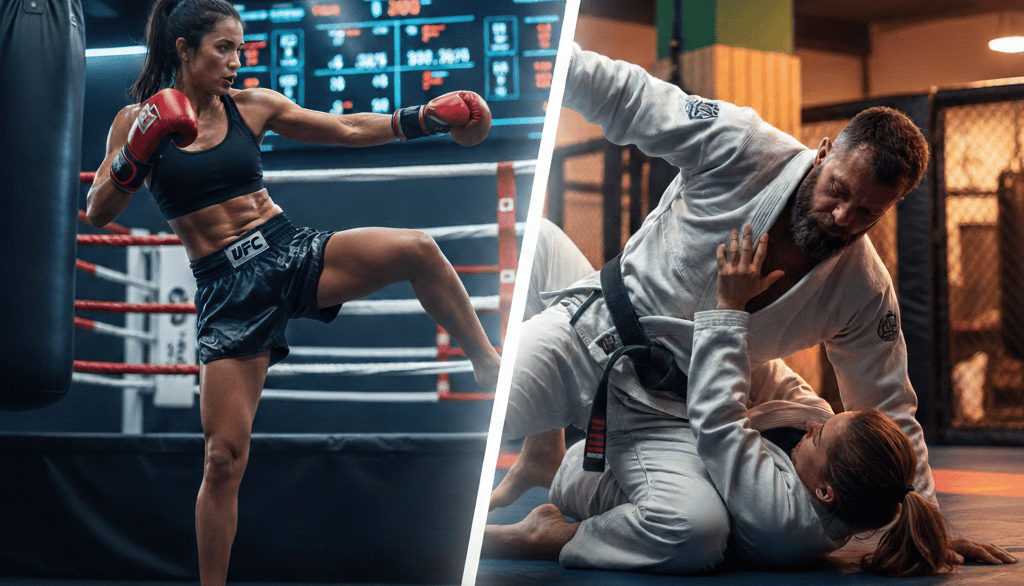
The Question: A common debate on Reddit's r/MMA_Academy and r/martialarts is: "If you could only choose one for a real-life situation, is it better to be a striker (Muay Thai/Boxing) or a grappler (BJJ/Wrestling)?"
This is the "Oldest Question" in combat sports. In the early 90s, the first UFCs proved that if you don't know how to grapple, you’re in trouble. But as we move through 2026, the answer has become more nuanced. The "pure" specialist is a dying breed; today, it’s about Distance Management.
Here is the breakdown of how these two "families" of fighting compare in the modern era.
The Tale of the Tape: Striking vs. Grappling
Striking (Muay Thai, Karate)
Primary Goal: Knockout or damage via impact
Range: Long to Mid-range
Learning Curve: High "Early" Competence (2-3 months)
Self-Defense: Best for multiple attackers
Grappling (BJJ, Wrestling)
Primary Goal: Control and submission via leverage
Range: Close-range to the Ground
Learning Curve: High "Late" Competence (1-2 years)
Self-Defense: Best for single, larger attacker
The Case for Striking
"Don't Touch Me"
Striking is about geometry and timing. If you can hit someone from a distance and move away, you are safe.
The 2026 Advantage: Striking is excellent for cardiovascular health and building lightning-fast reflexes. In a self-defense scenario, the ability to "stun and run" is often smarter than tying yourself to an attacker on the pavement.
The Reality Check: A striker’s worst nightmare is a "clinch." If a grappler gets their hands on you, your punching power drops to nearly zero.
The Case for Grappling:
"The Gentle Art of Control"
Grappling is physical chess. It's about taking away an opponent's options until they have nowhere to go.
The 2026 Advantage: This is where the "Gentle" in Gentle Art comes in. In a world where legal liability is a real concern, grappling allows you to neutralize a threat (like a drunk relative or an aggressive person) without actually hurting them. You can hold someone down until help arrives.
The Reality Check: "The ground is a dangerous place." Grappling is incredibly effective one-on-one, but it leaves you vulnerable if the attacker has friends nearby.
The "Hybrid" Verdict
If you are looking for the "ultimate" answer, the trend in 2026 is The 70/30 Rule. Most experts now recommend picking a "base" (what you enjoy most) and spending 30% of your time learning the "defense" of the other.
If you love Striking: Learn enough "Takedown Defense" so you can stay on your feet.
If you love Grappling: Learn enough "Distance Management" so you don't get hit while closing the gap.
The "Mat Pro" Tip: The "Hard Floor" Warning
One thing Reddit users often overlook is the surface. Rolling on a padded mat is a dream; grappling on concrete or gravel is a nightmare for your skin and joints. If you are a BJJ enthusiast, youshould emphasize the importance of takedowns and staying on top, rather than "pulling guard" in a real-world setting.